Underfloor heating vs radiators: running costs at 2026 UK tariffs
On October 29, 2026 by swllwheatinThe short answer: the heat source and flow temperature decide the bill, not the emitter alone
Ask whether underfloor heating (UFH) is cheaper to run than radiators and you will get confident, contradictory answers. Both can be true, because the question is incomplete. A wet underfloor system fed by a gas boiler, a wet system fed by a heat pump, and an electric mat system fed by the mains are three different heating systems that happen to share a name.

The honest summary:
- Wet UFH on a heat pump is usually the cheapest combination here, because underfloor heating is designed for the low flow temperatures at which heat pumps are most efficient.
- Wet UFH on a gas boiler is typically close to radiators on the same boiler, sometimes a little cheaper, because the boiler spends more time condensing. It is not automatically much cheaper.
- Electric UFH for a whole house is usually the most expensive option, because electricity costs far more per unit than gas. It makes most sense in a small room, used for short periods — a bathroom or a small kitchen floor, not a whole house left on all winter.
The tariffs used in this article
All maths uses the Ofgem price cap average rates for direct-debit customers in England, Scotland and Wales for 1 October to 31 December 2026, as reported from Ofgem's published figures:
- Electricity: 26.32p per kWh, standing charge 54.83p per day
- Gas: 7.97p per kWh, standing charge 29.68p per day
Two cautions matter. These are national averages; your regional rate and tariff will differ. And the cap changes quarterly — the January to March 2027 cap was not known at the time of writing. Domestic electricity VAT was temporarily removed from 1 October 2026 to 31 March 2027, already reflected in the electricity figure; gas still includes 5% VAT. If you are on a fixed or time-of-use tariff, put your own unit rates into the formulas below — the method matters more than any single number here.
How each system heats a room
Radiators
A radiator is a relatively small surface, so it needs hot water to give off enough heat. Traditional systems commonly run at flow temperatures of 60–75°C. Heat reaches you mainly by convection: air warms against the panel, rises and circulates. That works fast — a radiator system typically warms a room noticeably within 20–40 minutes.
The trade-off is unevenness. Air near the ceiling is warmer than air at ankle height, rooms can have warm and cold spots, and furniture in front of a radiator blocks output. Thermostatic radiator valves (TRVs) help room by room, but they cannot change the basic physics of a small, hot surface heating by convection.
Wet underfloor heating
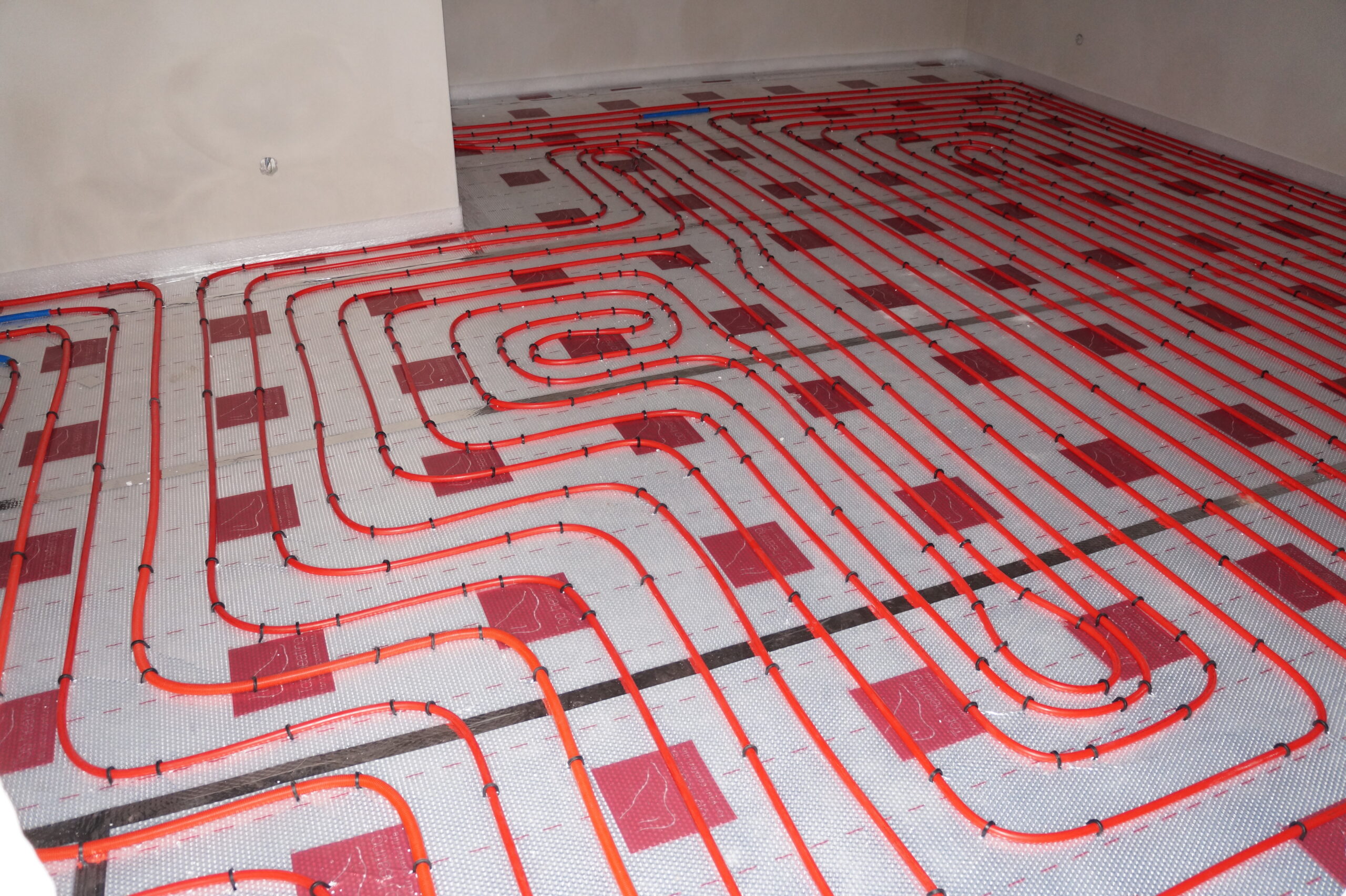
A wet system circulates warm water through pipes in or under the floor. The floor itself becomes the emitter, so the surface area is enormous compared with a radiator. It can therefore deliver the same heat with much cooler water, typically a flow temperature of 35–45°C and a floor surface temperature around 25–30°C. Heat reaches you mainly by radiation from the floor, giving even warmth and warm feet — provided the system is designed for the room's heat loss and the floor finish allows heat through. Thick carpet with thick underlay insulates against the heat you are trying to deliver; tile, stone, engineered wood and suitable vinyl are far better partners.
The trade-off is speed. A screeded wet floor can take two to four hours to bring a cold room up to temperature, because you are warming a slab, not just air. Underfloor heating rewards steady, continuous running at a lower temperature, not on-off bursts. If your pattern is "heating on for an hour in the morning, off all day, on again in the evening," radiators will feel more responsive.
Electric underfloor heating
Electric systems use heating cables or mats under the floor, powered directly by mains electricity. They are thin, comparatively easy to install, and ideal for retrofitting a single room without plumbing work. Their running-cost problem is simple arithmetic: they convert electricity to heat at effectively 100% efficiency at the point of use, but electricity at 26.32p per kWh is roughly 3.3 times the price of gas per kWh. Efficiency cannot overcome a fuel that costs three times as much.
The maths: cost per useful kilowatt-hour of heat
Compare cost per useful kWh of heat delivered to the room, not cost per hour of operation — an hour of a small bathroom mat and an hour of a whole-house system are not comparable.
- Gas boiler at 90% efficiency: 7.97p ÷ 0.90 = 8.86p per useful kWh
- Electric heating (100% at point of use): 26.32p ÷ 1.00 = 26.32p per useful kWh
- Heat pump at SCOP 3.5: 26.32p ÷ 3.5 = 7.52p per useful kWh
- Heat pump at SCOP 3.0: 26.32p ÷ 3.0 = 8.77p per useful kWh
- Heat pump at SCOP 2.5: 26.32p ÷ 2.5 = 10.53p per useful kWh
SCOP — seasonal coefficient of performance — is the average number of units of heat a heat pump delivers per unit of electricity over a heating season. It is not a laboratory COP measured at one mild outdoor temperature. Flow temperature is the single biggest influence on it: the cooler the water a heat pump has to produce, the higher the SCOP.
Apply those figures to a home needing 10,000 kWh of useful heat a year — a reasonable illustration for a moderately insulated three-bedroom home, not a promise for any particular house:
| System | Fuel needed | Annual fuel cost at Oct–Dec 2026 cap rates |
| Gas boiler (90%), radiators or wet UFH | 11,111 kWh gas | £886 |
| Heat pump, SCOP 3.5 (UFH at 35–45°C) | 2,857 kWh electricity | £752 |
| Heat pump, SCOP 3.0 (well-sized radiators at 50–55°C) | 3,333 kWh electricity | £877 |
| Heat pump, SCOP 2.5 (undersized radiators forcing 60°C+) | 4,000 kWh electricity | £1,053 |
| Electric UFH, whole house | 10,000 kWh electricity | £2,632 |
Standing charges are excluded because you pay the electricity standing charge whatever system you choose, and the gas standing charge (about £108 a year at 29.68p per day) only disappears if you disconnect gas entirely. That saving is real for an all-electric home, but it should not be counted as a saving of underfloor heating itself.
Read the table carefully. On gas, the emitter barely changes the fuel bill — the boiler's efficiency does. The often-quoted claim that wet underfloor heating is 25–40% cheaper than radiators on the same boiler should be treated with caution: lower flow temperature does help a condensing boiler condense more often, which genuinely improves efficiency, but the gain depends on return temperatures, controls and balancing. A well-set-up radiator system with weather compensation can close much of the gap. Where underfloor heating earns a large saving is on a heat pump, because dropping flow temperature from 60°C-plus to 35–45°C can lift SCOP from around 2.5 to around 3.5 — worth about £300 a year on 10,000 kWh of heat in the table above.
Installation costs and payback
Running costs alone do not settle the decision, because installation costs differ sharply. As a rough guide from trade cost guides, a whole-house radiator system is often around £3,000 for supply and installation where pipework already exists, a wet underfloor system around £8,000 for a typical home, and electric underfloor heating around £4,000 — but these vary widely with house size, floor construction and region, and should be treated as a starting point for quotes, not a quote.
That changes the payback arithmetic. If wet UFH on a heat pump saves £130 a year against radiators on the same heat pump (SCOP 3.5 versus 3.0 in the table), then against an extra £5,000 of installation cost, payback on fuel alone is very long. That is why underfloor heating is usually justified as part of a renovation or new build, or for comfort and space, rather than as a pure fuel-saving retrofit. The case strengthens if the alternative is replacing undersized radiators anyway, or if the home is off the gas grid and the comparison is against oil or LPG.
Lifespans differ too. Radiators typically last 15–25 years depending on material and water quality, and individual radiators are easy to swap. Wet underfloor pipework, properly installed, can last 40–50 years, though manifolds, pumps and controls need attention sooner. Electric mats last roughly 25–30 years but are hard to repair if a cable fails under a finished floor.
When each system wins
Choose radiators when: you are retrofitting without lifting floors; rooms are used intermittently and need fast warm-up; you want cheap room-by-room zoning; or you are on mains gas with a modern condensing boiler and the fuel saving from underfloor heating would not repay the disruption.
Choose wet underfloor heating when: you are building, extending or renovating and floors are already coming up; you are installing a heat pump and want its SCOP as high as possible; the home is occupied most of the day and suits steady, low-temperature heating; or you want even warmth and clear walls in open-plan or tiled spaces.
Choose electric underfloor heating when: it is a single small room, especially a bathroom or small kitchen; it will run for short periods rather than as the home's main heating; and you accept that you are paying for comfort, not the cheapest heat. Do not choose it as whole-house heating on a standard tariff without doing the table maths first.
How to cut the bill whatever emitter you have
1. Lower the flow temperature. On a condensing gas boiler, lower flow — with weather compensation if supported — keeps the boiler condensing. On a heat pump, every degree matters even more. Ask your installer what flow temperature your system is designed for, and what it actually runs at. 2. Balance the system and bleed radiators. Cold spots and rooms that never warm up while others overheat are usually balancing or air problems, not a sign you need a new system. 3. Insulate first. Loft and cavity wall insulation, draught-proofing and sensible thermostat settings reduce heat demand itself, which cuts the bill under any emitter and may let a heat pump run at a lower flow temperature. 4. Check your tariff. Time-of-use tariffs can change heat pump and electric underfloor economics, but only if running can genuinely shift into cheap periods.
Frequently asked questions
Is underfloor heating cheaper to run than radiators?
It depends on the heat source. Wet UFH with a heat pump is usually cheaper than radiators with the same heat pump, because low flow temperature raises efficiency. Wet UFH with a gas boiler is usually similar to radiators, perhaps slightly cheaper. Electric UFH is usually more expensive than gas-heated radiators, because electricity costs about 3.3 times as much per kWh as gas at the October–December 2026 cap rates.
Do I need to replace radiators if I get a heat pump?
Not necessarily, but they must deliver enough heat at the heat pump's lower flow temperature. Many existing radiators are undersized for 45–50°C flow and need upsizing. A room-by-room heat loss calculation, not a guess, decides this.
Bottom line
Do not buy an emitter; buy a system. On gas, radiators are hard to beat on cost and responsiveness, and underfloor heating is a comfort and renovation choice. With a heat pump, underfloor heating lets the heat pump do its best work — that is where the saving is real. Considering electric underfloor heating? Run the per-kWh maths first: a lovely bathroom floor, and a dear way to heat a house.
Related reading
- Gas boiler vs heat pump: running costs compared 2026
- Are heat pumps worth it in the UK? Honest 2026 assessment